Marie Curie: The Discovery That Crowned Her and Killed Her
Available in: PT
Marie Curie's laboratory notebooks are kept at the National Library of France, inside lead-lined boxes. Anyone who wants to consult them has to sign a waiver. Almost a century after her death, the paper is still radioactive — and will remain so for another sixteen hundred years.
It is the most precise measure of what this story cost. Marie Curie discovered two elements, named a phenomenon, won two Nobel Prizes in different sciences and became the first woman to teach at the Sorbonne. And she did all of it handling, with her bare hands and no protection whatsoever, the material that would kill her.
She began by looking death in the face, at ten years old.
▶️ Prefer to watch? This story is a full video documentary, with original imagery and score, on the Zigurat channel: https://youtu.be/zTviF1mpDwk
Warsaw, under three empires
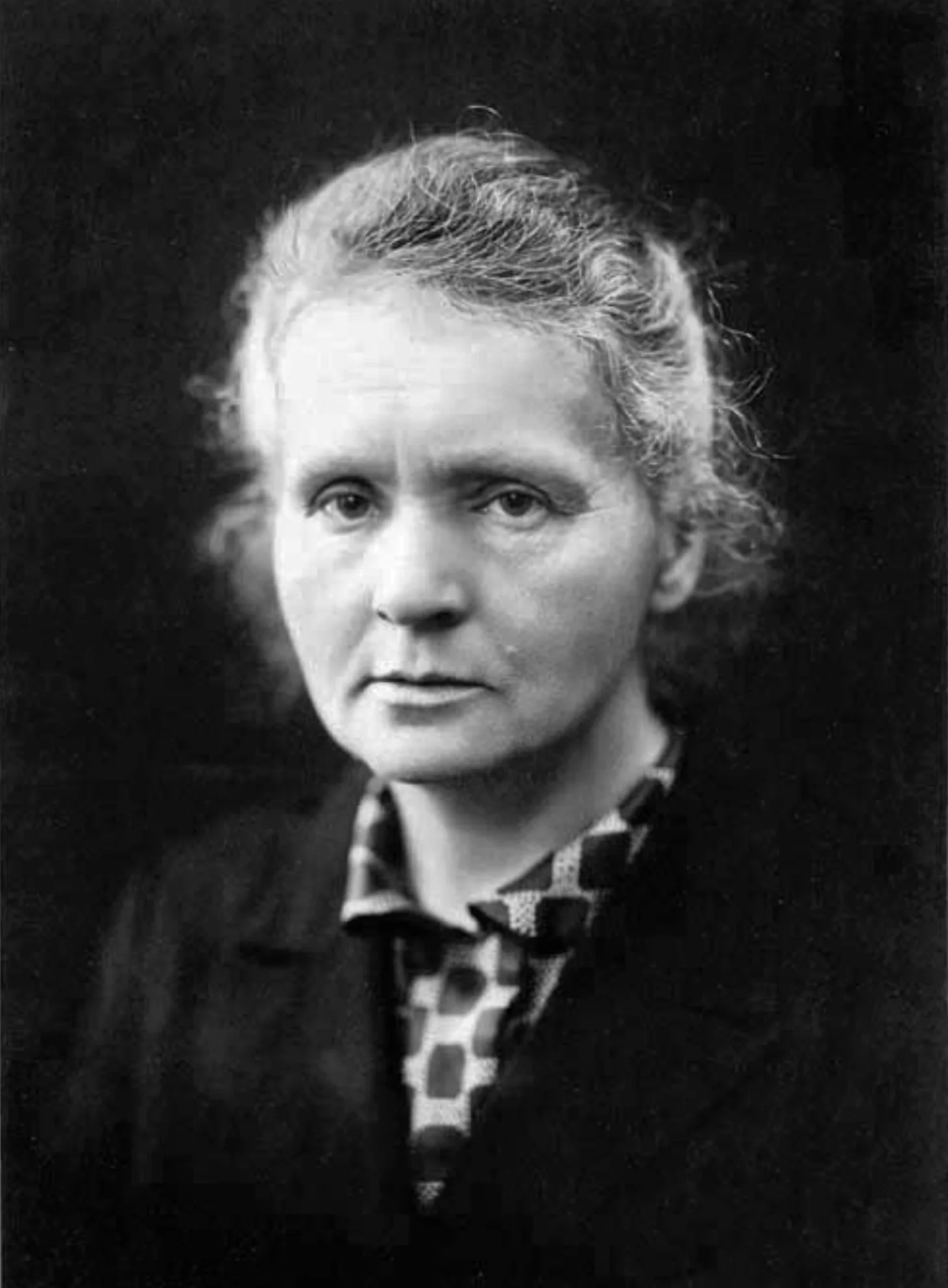
Maria Skłodowska was born on 7 November 1867 in Warsaw. Poland did not exist as a country: it had been carved up between Russia, Prussia and Austria, and the capital lived under the iron grip of the Russian tsars.
She was the youngest of five children of Władysław Skłodowski, a professor of physics and mathematics, and Bronisława Boguska Skłodowska, headmistress of a respected boarding school for girls. Before her came Zofia, Józef, Bronisława and Helena.
In 1876, Zofia, the eldest, died of typhus. Two years later tragedy returned. Bronisława had long been fighting a losing battle against tuberculosis and, fearing she would infect her children with a then-incurable disease, kept her distance from them — a sacrifice that marked Maria's childhood deeply.
It was standing before her mother's body that something shifted permanently in the mind of that ten-year-old girl. The spark of life had gone, leaving only matter in transformation. For Maria, in that instant, death stopped being a mystery held up by faith and became a fact — something you observe, measure, study.
The Flying University
For ten years she buried herself in books with a near-ferocious discipline, finishing secondary school at the Imperial Gymnasium with a gold medal. But the Russian regime barred women from conventional universities.
Her answer was an act of resistance: Maria began attending the Flying University, a clandestine institution that educated Polish youth in borrowed rooms, changing address to stay ahead of the tsarist police. There, once again, she stood out among her peers.
What was missing was money. With her sister Bronisława, who dreamed of studying medicine, she made a pact: Maria would fund Bronia's studies in Paris and, once qualified, her sister would fund hers. To hold up her end she tutored privately in Warsaw and, in 1886, took a post as governess in Szczuki, a village some 80 kilometres north of the capital.
There she fell in love with the family's eldest son, Kazimierz Żorawski, a brilliant mathematics student just a year older than her. The Żorawski family objected fiercely: a governess was socially beneath them. After years of uncertainty, the courtship collapsed under the weight of class convention, and Kazimierz abandoned her for good.
In 1889, heartbroken, Maria returned to Warsaw. She resumed private tutoring and, through a cousin's intervention, gained access to a laboratory at the Museum of Industry and Agriculture — where she could finally put her hands on what she knew only from books. Even so, embittered, she came close to abandoning science altogether.
It was Bronia, now qualified, who intervened at the decisive moment: she honoured her side of the pact and called her sister to Paris.
Paris, 1891
Maria followed her sister and moved to Paris, where she felt freer than she ever had. She lived at first with Bronia and her brother-in-law Kazimierz Dłuski — a cruel coincidence, the same first name as her former love. Both socialist-minded doctors, they had turned their apartment into a refuge offering free medical care to the neighbourhood's poor. The constant bustle bothered Maria, who was used to silence.
In March 1892 she moved to the Rue Flatters, in search of the privacy her studies demanded. Now enrolled at the Sorbonne's Faculty of Sciences, she began signing her name Marie.
Her mentor, Professor Gabriel Lippmann, assigned her a study of the magnetic properties of certain steels, commissioned by the Society for the Encouragement of National Industry. The problem was that Marie did not know the field. So she sought out one of France's leading specialists in magnetism — Pierre Curie, a physicist already renowned for his pioneering work on piezoelectricity and for the ingenuity of his experimental designs.
The connection was instant. Even so, in 1894, Marie made an unexpected decision: she returned to Poland, intending to pursue a career in secondary teaching. Pierre, feeling her absence keenly, wrote trying to persuade her to come back and work at his side — imagining the two of them passing through life near each other, hypnotised by their own dreams, her patriotic one, and the humanitarian and scientific ones they shared.
Marie returned. On 25 July 1895, with her father's blessing, they married in a modest civil ceremony in Sceaux, south of Paris.
The year the invisible appeared
At the very end of 1895, the German physicist Wilhelm Conrad Röntgen sent colleagues something that defied the logic of the age: photographs of the bones of his wife's hand, her wedding ring visible beneath the flesh. These were X-rays. The scientific world went into shock.
Shortly afterwards, in Paris, it was Henri Becquerel's turn to stumble on a discovery. Uranium salts forgotten on a photographic plate in a dark drawer had emitted a radiation capable of marking the paper. He called them uranic rays — but the origin of that emission remained a total mystery.
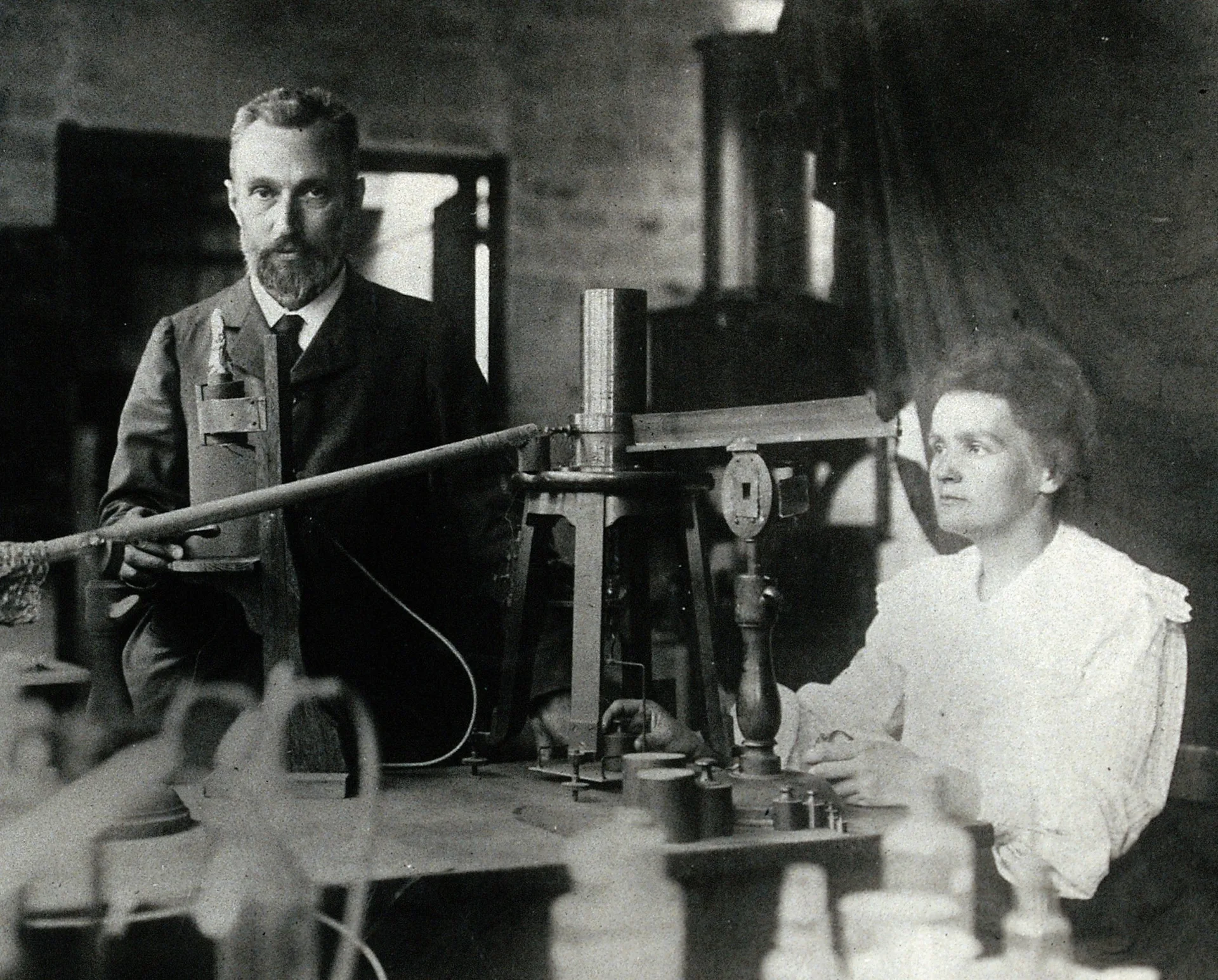
While the uproar over X-rays overshadowed Becquerel's finding, Marie was intrigued by precisely what nobody was looking at. She realised his approach was insufficient to explain the nature of the phenomenon, developed an unprecedented procedure for measuring the intensity of those radiations, and chose the subject for her doctorate. Using highly sensitive instruments built by Pierre, she carried out the first quantitative analysis of uranium rays — and named the phenomenon radioactivity.
Then she formulated the hypothesis that would change physics: radioactivity was not the result of an external chemical reaction but an intrinsic property of the atom itself. The claim collided head-on with the principle of causality and appeared, at first glance, to threaten the law of conservation of matter — one of the unshakable pillars of nineteenth-century physics.
Ironically, when the New Zealander Ernest Rutherford proposed that an atom, on emitting radiation, transformed its own chemical identity, Marie resisted: the idea of one element becoming another sounded to her like a return to alchemy, without the experimental evidence she considered definitive. History would end up proving both of them right.
Investigating uranium-rich minerals, she noticed something troubling: pitchblende was more radioactive than pure uranium. There was only one possible explanation — an unknown element was hiding inside it. Lippmann presented the results to the Academy of Sciences on 12 April 1898.
Pierre, intrigued by his wife's data, abandoned his own research on crystals to join her.
A cross between a stable and a potato cellar
The couple's laboratory was a dilapidated shed in the courtyard of the School of Industrial Physics and Chemistry in Paris — a former cadaver dissection room, abandoned because it had fallen into ruin. Dismal, poorly ventilated, leaking. The chemist Wilhelm Ostwald, on visiting, could not contain his shock: the place struck him as a cross between a stable and a potato cellar.
Out of that shed came polonium, announced in July 1898 and named for a homeland that did not exist on any map, and radium, in December of the same year.
The scientific community was not convinced. To accept new elements, it demanded to see them isolated in pure form with their atomic weight determined. So Marie made a monumental decision: she would produce pure radium, a substance many considered a chimera.
Her calculations showed that tons of raw ore would be needed to extract a minuscule fraction. Obtaining that volume in Paris was impossible, and the couple had no money. Pierre searched across Europe until he located the Sankt Joachimsthal mine in Bohemia, where tons of pitchblende residue lay discarded as waste after uranium extraction. He convinced the director to grant him ten tons. Transport was only possible with the backing of the Rothschild family — the networking of Henri de Rothschild, a physician and science enthusiast, and the logistical support of Baron Edmond de Rothschild.
In the spring of 1899 the tons of ore were dumped in the courtyard, piled up in front of the shed. There the work began.
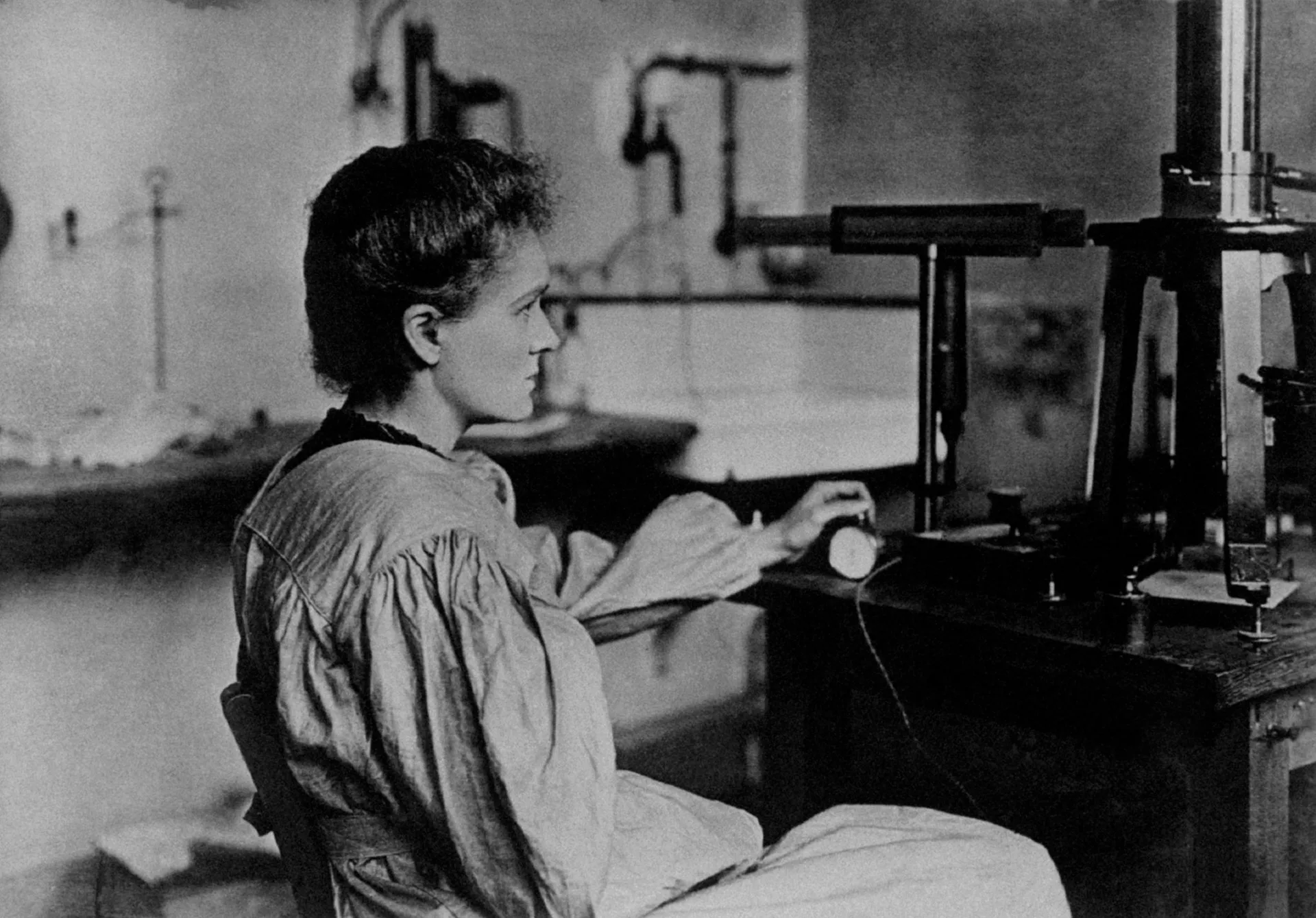
Amid the pungent smell of acids and bases, Marie developed and refined a rigorous technique of fractional crystallisation — an exhausting process of chemical separation she would repeat hundreds of times. She stirred cauldrons with an iron rod nearly her own height. As purification advanced, the substance took on a ghostly bluish luminescence that lit the shed by itself at night.
In the summer of 1902, after years of superhuman effort, the couple held a few decigrams of pure radium chloride. With that sample Marie determined the atomic weight precisely and fixed the atomic number at 88, establishing radium as an undeniable element of the periodic table.
The invisible cost
Cycling was the only possible escape from the confinement of the shed. The couple had spent their wedding gift money on modern bicycles with rubber tyres, and rode whenever they could. On one of those outings Marie was pregnant with her second child.
Shortly afterwards, physical exhaustion and the fragility of a body already punished by continuous exposure to radioactive material led to the loss of the child.
It was because of complications from that loss that Marie was unable to travel to Stockholm for the 1903 Nobel Prize in Physics ceremony, awarded jointly to her, Pierre and Henri Becquerel for their research on radiation. Even in her absence, the recognition established the couple as the foremost figures of the new physics.
The triumph already carried its invoice. Glory was beginning to eclipse the health of both, who increasingly felt the symptoms of an exposure the world did not yet know to be lethal.
19 April 1906
On a rainy afternoon, Pierre Curie was crossing the Rue Dauphine in Paris in a downpour when he slipped and fell into the path of a heavy horse-drawn wagon. Death was instantaneous.
For Marie, the world collapsed. Pierre was not only her husband and companion: he was her indispensable intellectual partner and the foundation of her research. The shock plunged her into deep mourning and into a silence that only scientific work seemed, slowly, able to break.
Alone, with two small daughters and the responsibility of carrying forward research the world was beginning to revere, she took over Pierre's chair of physics at the Sorbonne — becoming the first woman to teach at the institution.
Two Nobels, and a daughter
The year 1911 marked the height of her international recognition. After years of solitary work, the global scientific community honoured her again with the Nobel Prize in Chemistry. Marie became the first person in history to be awarded two Nobel Prizes — and remains, to this day, the only one to have received them in two different sciences.
In the years that followed, her legacy found its natural extension in her daughter, Irène Joliot-Curie. Raised among her parents' instruments and notebooks, Irène became her principal collaborator — and accompanied her mother to the front lines of the First World War, where they operated mobile radiology units the soldiers nicknamed petites Curies. The joint effort would bear fruit: years later, Irène would receive her own Nobel Prize in Chemistry for the discovery of artificial radioactivity.
4 July 1934
After decades of handling radioactive material without the protections we now consider basic, Marie's body began to fail. She died on 4 July 1934 of aplastic anaemia — her bone marrow destroyed by prolonged exposure to radiation.
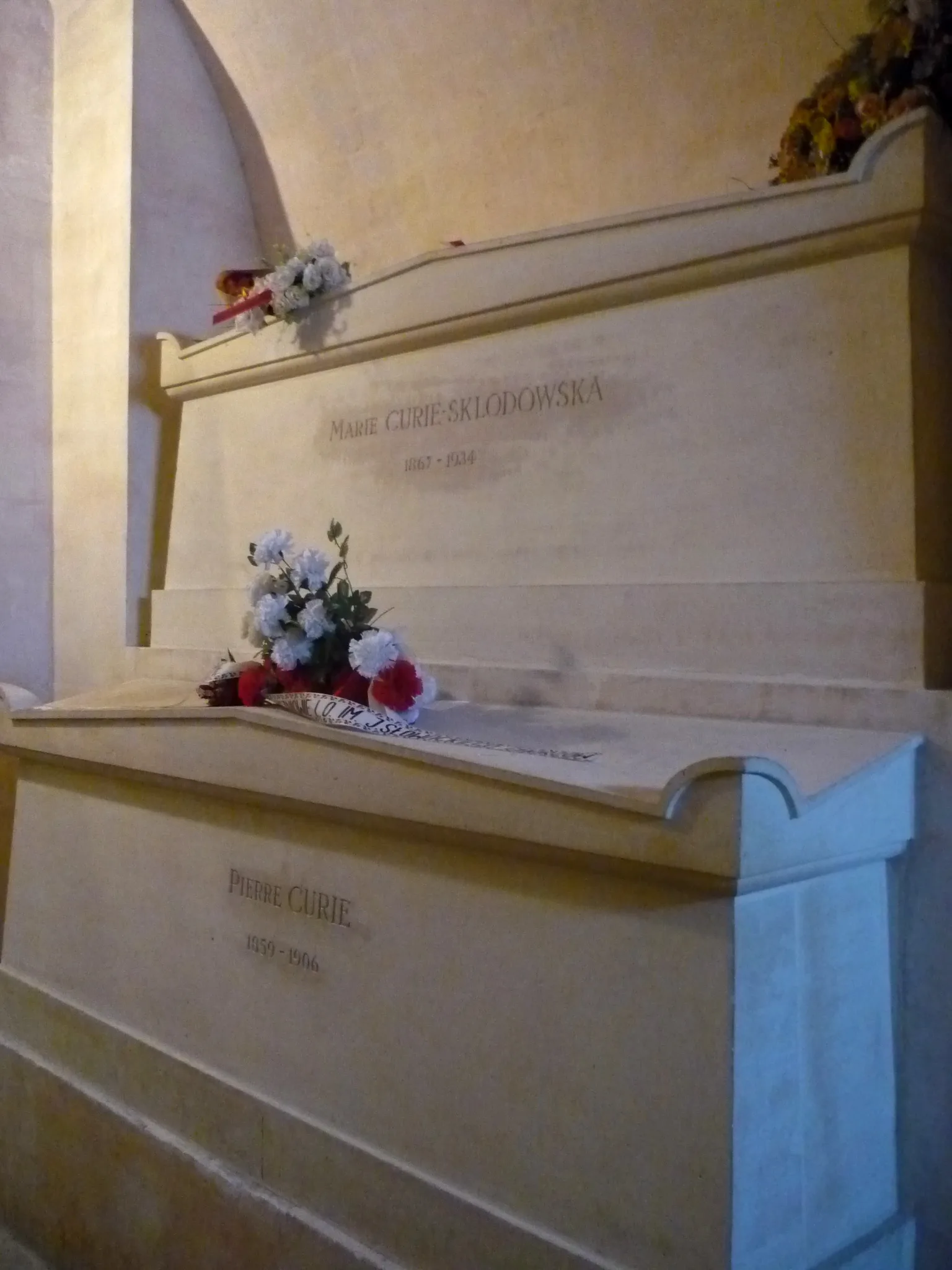
In 1995, in an unprecedented honour, the remains of Pierre and Marie were transferred to the Panthéon in Paris, placing them among the national heroes of France. Marie was the first woman admitted there on her own merit. Her coffin had to be lined with lead.
What remains
The radium that lit a wooden shed with ghostly light is today both things at once: a symbol of human audacity and a reminder of the personal price knowledge sometimes demands.
Marie Curie was not the victim of her own naivety. She was the victim of the fact that, at that moment, nobody knew. She and Pierre carried samples in their waistcoat pockets to show visitors. They kept glowing vials on the bedside table because they found them beautiful. Radioactivity was enchanting before it was dangerous — and somebody had to find out, in their own body, which of the two it was.
She found out. And the science that had been the compass of her existence went on shining through Irène, and through everyone who decided, after her, to push at the frontiers of the invisible.
▶️ Watch the full story
This article was born from the Marie Curie episode on the Zigurat channel — documentaries that open the files of lives history preferred to tell only halfway. The video tells this story with reconstructions, an original score and an atmosphere the text can't reach: https://youtu.be/zTviF1mpDwk
If this story held you, subscribe to the channel — and explore other episodes of the series on the blog.
Frequently asked questions
Who was Marie Curie?
A Polish-born, naturalised French physicist and chemist (1867-1934). She named the phenomenon of radioactivity, discovered polonium and radium alongside Pierre Curie, and became the first woman to teach at the Sorbonne. She received the Nobel Prize in Physics in 1903 and in Chemistry in 1911.
Why did Marie Curie win two Nobel Prizes?
The first, in Physics in 1903, shared with Pierre Curie and Henri Becquerel, for their research on radiation. The second, in Chemistry in 1911, for the discovery of polonium and radium and the isolation of radium in pure form. She is the only person to have received Nobel Prizes in two different sciences.
What did Marie Curie die of?
Aplastic anaemia, on 4 July 1934 — her bone marrow destroyed by decades of exposure to radiation, at a time when neither protection nor any sense of the risk existed.
Are Marie Curie's belongings still radioactive?
Yes. Her laboratory notebooks are kept in lead-lined boxes at the National Library of France, and anyone consulting them signs a waiver. Radium-226 has a half-life of about 1,600 years.
Sources & references
- 01 The Nobel Prize — official biographies of Marie Curie (Physics, 1903; Chemistry, 1911)
- 02 Musée Curie, Paris — collection and documentation on the Curies and the rue Lhomond laboratory
- 03 Encyclopædia Britannica — Marie Curie
- 04 Bibliothèque nationale de France — conditions for consulting Marie Curie's notebooks
- 05 Panthéon / Centre des monuments nationaux — transfer of the remains of Pierre and Marie Curie (1995)

This article started as a video
Subscribe to the channel so you don't miss the next ones.